

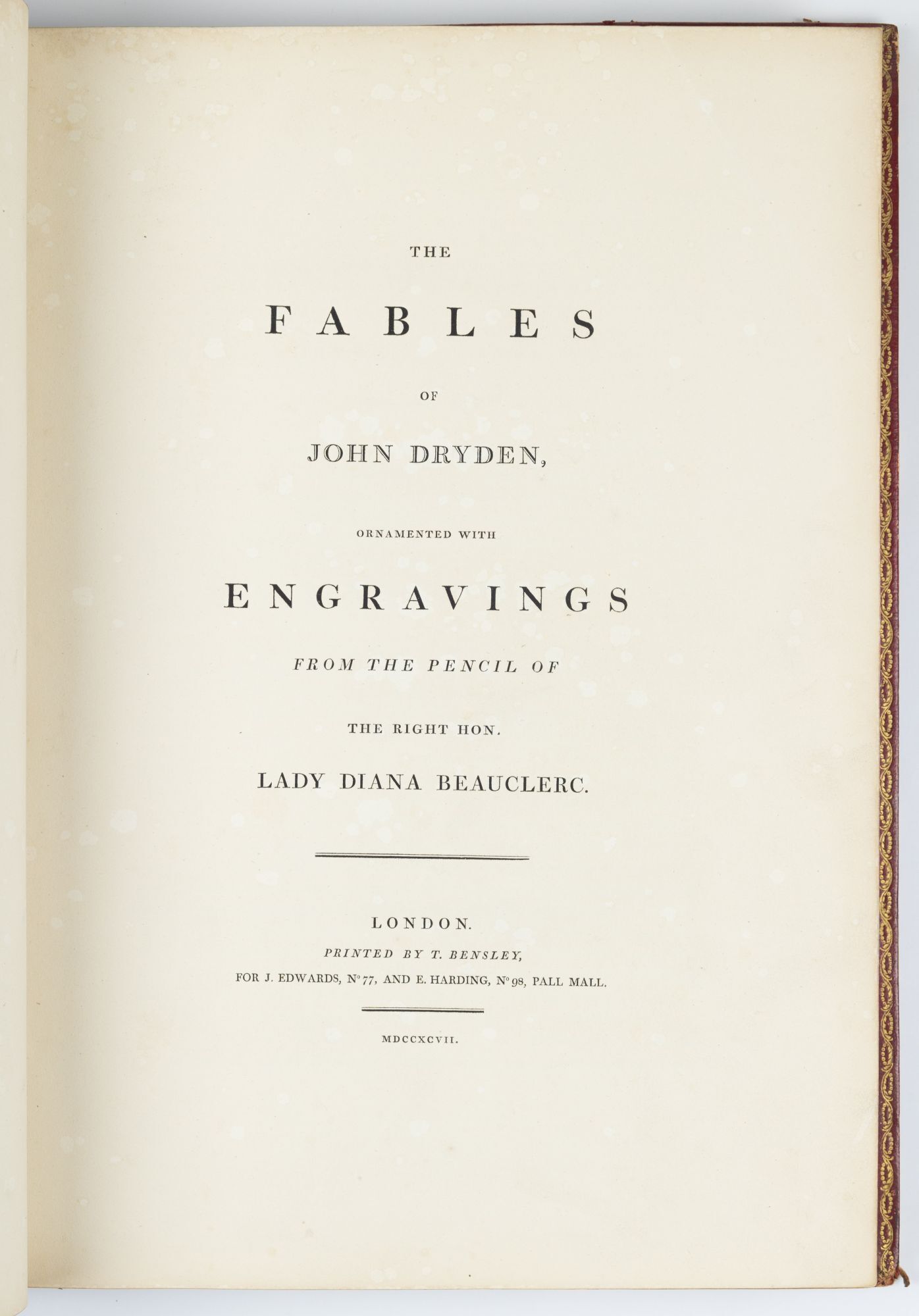


The fables of John Dryden, ornamented with engravings from the pencil of the Right Hon. Lady Diana Beauclerc
London: Thomas Bensley for John Edwards and Edward Harding, 1797.
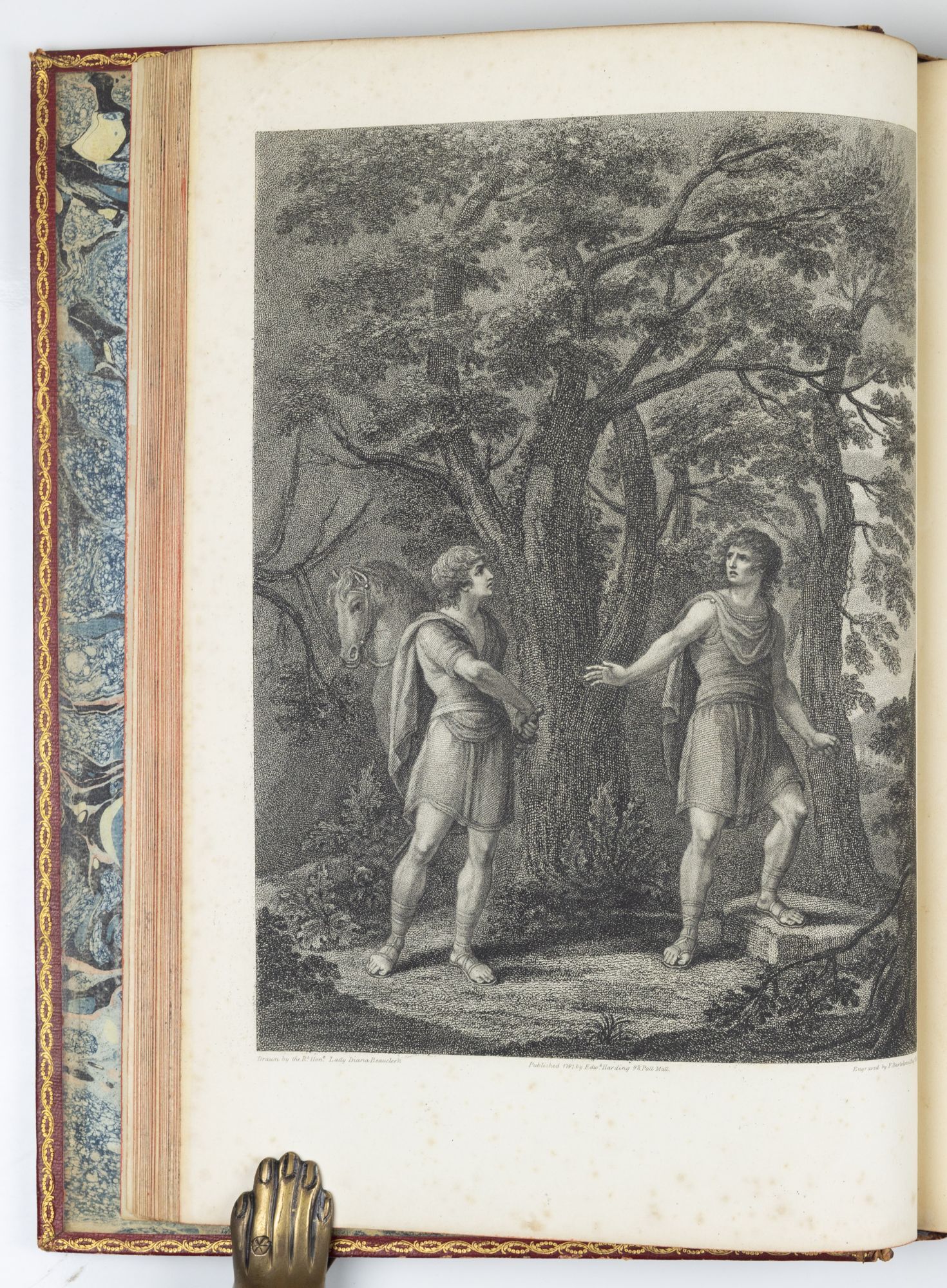
Folio (14 3/16” x 10 1/8”, 360mm x 257mm): binder’s blank, π2 a–d2 e2 (–e2) B2–3P2 χ2 (–χ2), binder’s blank [$1 signed; –B1, H1, 2I1, 2R1, 3K1, 3Q1]. 164 leaves, pp. [4] (half-title, blank, title, blank) i ii–xviii (18pp preface) 1–3 4–241 [1] (blank). With 9 engraved plates and 14 engraved vignettes.
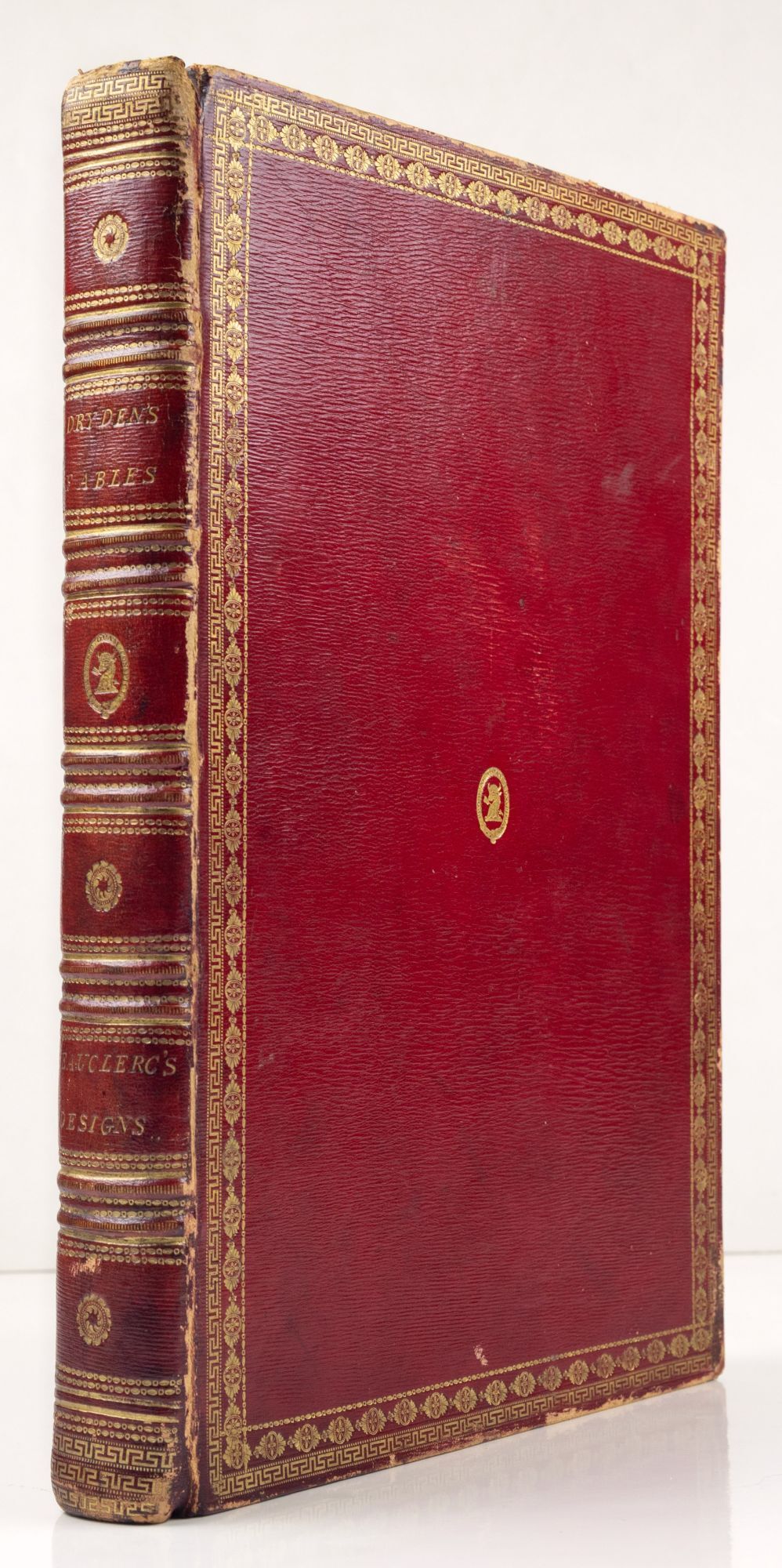
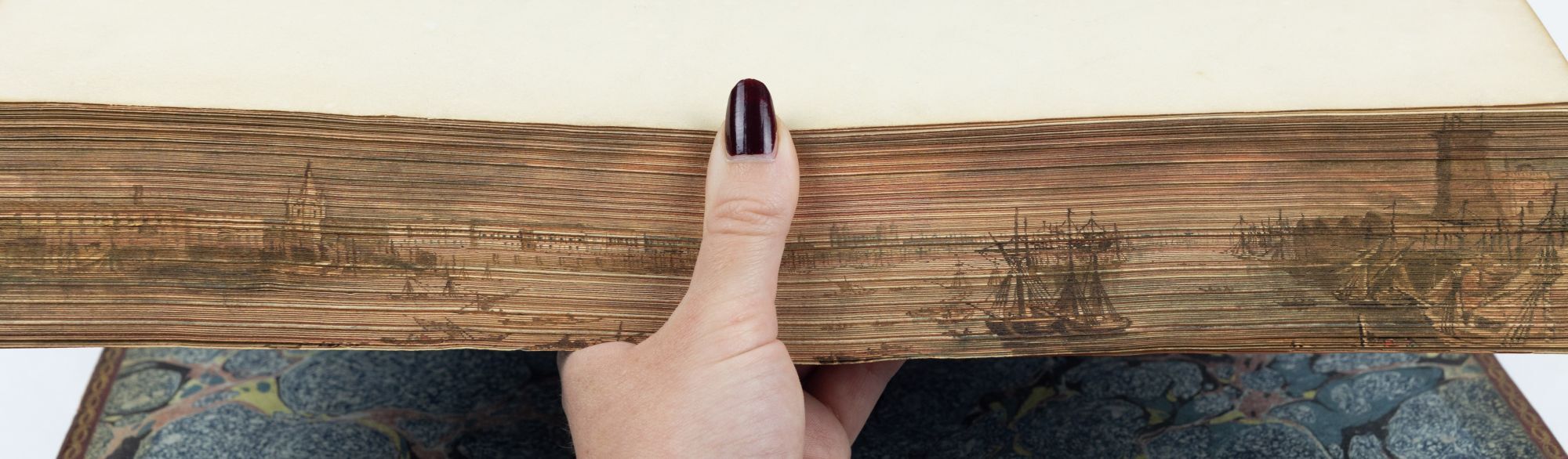
Bound in red straight grain morocco. On the spine, 6 panels. “DRYDEN'S / FABLES” gilt to the second panel, “BEAUCLERC'S / DESIGNS" gilt to the fifth. Gilt floral and Greek tau meander rolls to the boards. Superlibros of a bull encircled by a belt with the inscription “PRODESSE QUAM CONSPICI" gilt to the boards. Gilt dentelles. All edges of the text-block gilt, with a concealed fore-edge painting of the London harbor. Presented with a blue silk marking ribbon.
Extremities and joints worn. Starting at the tail. Offsetting to the plates and vignettes. Rear binder’s blank slashed vertically. Armorial bookplate of S.B. Boulton to the front pastedown.
John Dryden (1631–1700) was an influential English poet, satirist, playwright, and critic who dominated the literary scene of Restoration England. Born in Northamptonshire and educated at Westminster School and Trinity College, Cambridge, Dryden rose to prominence with his poem Heroique Stanzas (1659), commemorating Oliver Cromwell. His loyalty shifted with the monarchy, and he was elected Poet Laureate in 1668 following the Restoration of Charles II.
In Walter Scott’s 1963 biography of John Dryden, he describes the Fables as a complete miscellany. An atemporal collection, the fables span time and place to bring Homer, Ovid, Bocaccio, and Chaucer together as contemporaries. Throughout his career, Dryden often explored how people and societies act within the natural rhythms of history, finding his moral ideas in that process. In Fables, however, he moves away from strict historical order. Instead, he creates a world that recognizes and reveres history but does not depend on it. Here, moral meaning comes not from progress through time, but from an equilibrium — a universe defined and united by ongoing change rather than fixed direction.
This late XVIIIc release of Dryden’s Fables is richly illustrated by Lady Diana Beauclerk (here “Beauclerc”, 1734–1808). Born into the aristocracy and a line of formidable women — her great-grandmother being Sarah Churchill, Duchess of Malborough — Lady Beauclerk was known as something of a minx, with her very public divorce on the grounds of “criminal conversation” (adultery) warranting an Act of Parliament. Both her vivacious personality and artistic talents earned her a place in the public’s heart. Walpole and Reynolds were among her admirers, and several of her drawings were engraved by Bartolozzi. In addition to her works on paper, she designed bas reliefs for the now iconic Wedgwood company.
Samuel Bagster Boulton (1830–1918) was born in London and rose to prominence through his success as a timber merchant and later in the chemical and allied industries. Boulton was the first baronet of Copped Hall, a Knight of Grace of the Order of St John of Jerusalem in England, Lord of the Manor of Totteridge, Justice of the Peace, and Deputy Lieutenant of Hertfordshire. Copped Hall was later known as Darlands but was demolished in 1928. A plaque commemorating Samuel Boulton remains in St. Andrew’s church, reading “Whatsoever thy hand findeth to do, do it with thy might.”
Cataloged by G.R. Murdock
Item #GRM0040
Price: $15,000