




Galerie antique. Monumens de la grèce ou collection des chefs-dœuvre d'architecture, de sculpture et de peinture antique. Gravés d'après les meilleurs auteurs, comparés entre eux et accompagnés d'un texte historique, analytique & descriptif. Par J. G. Legrand. Première Division. Tome 1er à Paris. 1808
THE AUTOGRAPH MANUSCRIPT OF LEGRAND’S
UNFINISHED TREATISE ON THE ART AND
ARCHITECTURE OF ANCIENT GREECE
Legrand, Jacques Guillaume. Galerie antique. Monumens de la grèce ou collection des chefs-dœuvre d’architecture, de sculpture et de peinture antique. Gravés d’après les meilleurs auteurs, comparés entre eux et accomagnés d’un texte historique, analytique & descriptif. Par J. G. Legrand. Première Division. Tome 1er à Paris. 1808. (I.e., 1807.)
Folio (18 1/2” x 12”, 472mm x 305mm): 11 (blank) 2-82, 9-162, 172, 182, 19-222. 43 leaves, pp. [40] (2pp. blank, title, blank, 36pp. text), [46] (45pp. plates, blank). With illustrations for 93 plates on 86 mounted pieces of tissue, with text and some extensions of the plate on the leaf itself.
Tape-bound in five sections (quires 1-8, 9-16, 17, 18, 19-22), without wrappers. Watermarked “Brooksbank”, countermarked with a bunch of grapes.
Disbound (though likely never bound). Small splits or chips at the edges (1/2”-square loss to the initial blank), with some occasional soiling at exposed edges. A little foxing and toning at the plates, offsetting to the final leaf of the text (91). Tissue tanned. Some light marginal graphite printer’s marks throughout. With all deckles preserved. Written in a fine cursive of a single hand (viz. Legrand’s), including the plates’ captions. Plates drawn in pen-and-ink, several with a pink wash, a few with ink wash as well.
Jacques-Guillaume Legrand (1753–1807[1]) was France’s great historian-architect of the period surrounding the Revolution. With his partner Jacques Molinos, he traveled in Italy — notably Paestum — to study Greek architecture autoptically and through careful measurement. Though his plan was to travel to Magna Graecia (the southern part of Italy settled by the Greeks from the VIIIc BC), he was recalled to France and was set eventually to restore the architectural damage done to Paris and its environs throughout the Revolution.
His practice largely does not survive, but his commissions were substantial: the dome of the Halle aux blés (grain market, now the site of La Bourse) was one of the most influential in British and American architecture, groundbreaking for its construction and proportion. His final commission was the restoration of the Basilica of Saint-Denis, just north of Paris, the burial site of France’s kings. So great was his dedication to the task that in order better to supervise the work he moved to the abbey-church, whose environment ultimately led to his death.
Greater, perhaps, than his output of built buildings was his publication record on the history of architecture, especially public architecture. He wrote on the architecture of France as well as that of Egypt, Syria, Italy, the Holy land and beyond. As a student of Blondel, he was profoundly curious about the architectural orders and their built forms as opposed to their descriptions in Vitruvius, Palladio, Vignoli and others.[2] The architecture of the Eastern Mediterranean provided the antecedents to the orders, and perspective on their origins.
Doubtless Legrand’s most ambitious publishing product was the Galerie antique, a vast treatise on the architecture and architectural sculpture (friezes, metopes, pediments) of the ancient world. The series — though not as such — had begun in 1798 as a collaboration with Philibert Boutrois. Its antecedents were, principally, the 1762(–1816) Antiquities of Athens of Stuart and Revett — which remained prohibitively expensive and unobtainable in France — and Julien-David Le Roy’s 1758 Ruines des plus Beaux Monuments de la Grèce. Legrand aimed to expand access to the honest and accurate analysis of Greek architectural principles, keeping students and practitioners away from “les imitations que les Romains en ont faites” (p. 4 printed, 22r MS) — especially in the case of Doric and Ionic structures.
The 1808 Monumens de la Grèce ou Collection des chefs-d’œuvre d’architecture (Paris & Strasbourg: Treuttel & Würtz), intended as a first instalment but the only one to be published, set about to disseminate the honest analysis of Greek architecture at a period in French history and architectural history that grasped for the ideals of Athens. The drawings by Boutrois and Delettre gave not only visual impressions but measurements (after Stuart) as well as geometric principles — a practical means of studying and deploying ancient architectural ideas without visiting Greece. Whereas in the XVIIIc it was the excavations at Herculaneum and Pompeii that furnished the material for a Roman neoclassicism, many of the great post-Revolutionary monuments of Paris — the church of La Madeleine being the prime example — draw directly on Greek architecture.
The present item is Legrand’s fair (printer’s) copy of the work — presented to the publisher for the purposes of typesetting, engraving and printing the book — with his notations of printed page-breaks (sometimes in the outer margin, but often within the graphite text-frame itself), which are largely accurate. Because Legrand died before publication, there was no opportunity either for authorial changes or, indeed, authorial objection to editorial changes. Beyond doubt is that the manuscript anticipated supplemental material (called in English “taking in” additional copy). At 22v Legrand calls for the “table chronologique des principales époques de l’histoire D’athenes” to be inserted. This happens again seven times (pp. 22v (translation of Stuart and Revett’s preface), 31v ((Plutarch’s) life of Pericles), 72r (Stuart on choral contests), 81r (life of Cimon), 91r (life of Theseus), 102r (life of Alcibiades), 111v (table of chapters)). Many of these are, of course, from other books, but at least two must have been present in other manuscripts or otherwise entrusted to the publishers.
On a number of bases, it is clear that the present work is preparatory for rather than derivative of the printed volume. Two marginal comments (in the same hand) are signed by a monogram that must be Legrand’s: 22v, specifying that the chronological table be an “extrait, relativement au monumens [monogram]”; and 142v (against pl. 29), instructing that the reader (or, perhaps, the engraver) “voyez mon vignole de detournelles [monogram]”, which must mean his personal copy.
Apart from these explicit expansions, there are countless tacit engrossments of Legrand’s text, which is in fact rather free from bombast. Take, for example, the opening of the work, in which Legrand underscores the import of the subject. He asks what savant has not studied the ruins of antiquity, including “Celles d’athènes et aux d’égypte” (22r). In the printed version text this is expanded: “celles d’Athènes, et tout récemment encore n’ont point desiré de partager les travaux et les recherches des Francais sur les vastes débris d’Alexandrie, de Memphis, de Thèbes, de Siène ou de Palmyre?” (pp. 1-2). Expansions of this sort are frequent throughout the work, indicating a liberal editorial process.
The account of inscriptions is particularly revealing: Legrand must only have had a cursory knowledge of Greek. Take, for example, the account of the inscriptions on the choragic monument of Thrasyllos. Below transcribes the MS text, the corresponding printed text and finally the modern edition of the inscription (underlinings indicate changes from one column to the next):
|
Manuscript (72r) |
Printed (p. 85) |
|
|
ΘΡΑΣΣΥΛΟΣ ΘΡΑΣΣΥΛΟΣ ΔΕΚΕΛΕΕΥΣ ΑΝΕΘΗΚΕΝ ΧΩΡΗΥOn ΝΙΚΕΣΑΣ ΑΝΑΡΙΝ ΙΠΠΟΘΟΟΩΝΥΙΔΙ ΦΥΛΕΙ ΕVΙΟΣ ΧΑΛΚΙΔΕΥΣ ΗΥΛΕΙΝΕΑΙΧΜΟΣ ΗΡΕΝ ΚΑΡΧΙΔΑΜΟΣ ΣΟΤΙΟΣ ΕΔΙΔΑΣΚΕΝ |
ΘΡΑΣΣΥΛΟΣ ΘΡΑΣΣΥΛΟΥ ΔΕΚΕΛΕΕΥΣ ΑΝΕΘΗΚΕΝ ΧΩΡΗΓΟΝ ΝΙΚΕΣΑΣ ΑΝΔΡΙΝ ΙΠΠΟΘΟΩΝΤΙΔΙ ΦΥΛΕΙ ΕVΙΟΣ ΧΑΛΚΙΔΕΥΣ ΗΥΛΕΙ ΝΕΑΙΧΜΟΣ ΗΡΕΝ ΚΑΡΧΙΔΑΜΟΣ ΣΟΤΙΟΣ ΕΔΙΔΑΣΚΕΝ |
Θράσυλλος Θρασύλλου Δεκελεεὺς ἀνέθηκεν χορηγῶν νικήσας ἀνδράσιν Ἱπποθωντίδι φυλῆι ⋮ Εὔιος Χαλκιδεὺς ηὔλει. Νέαιχμος ἦρχεν ⋮ Καρκίδαμος Σώτιος ἐδίδασκεν. |
The errors belie any real knowledge of Greek characters; Y and T, Γ and Π, Α and Δ are not clearly distinguished. Instead of N Legrand writes a large Latin minuscule “n.” The editors fixed some of these, but even basic Greek — the dative plural of the word for “man,” ανδράσιν, is printed as the nonsense ΑΝΔΡΙΝ — is muddled.
The rendering of the Greek in the plates again indicates that this was preparatory rather than derivative. Take, for example, the illustration of the monument of Thrasyllos (161v): the inscriptions are rendered essentially as squiggles. The inscriptions, being available within the text, could therefore be supplied to the engraver (Delettre in this case). Yet the Greek text within the printed plate is inferior to that in the printed text (e.g., IΠΠOΘΟΟΩΝΥΙΔΙ in MS (13r) ΙΠΠΟΘΟΩΝΤΙΔΙ in the text of the printed volume (p. 86) but ΙΓΓΟΟΟΩΝΤΙΔΙ on the printed plate (43). This suggests that the Delettre consulted the text of the MS (rather than the “corrected” printed text) to supply the inscription for the plate, but also being unfamiliar with Greek mis-interpreted the characters.
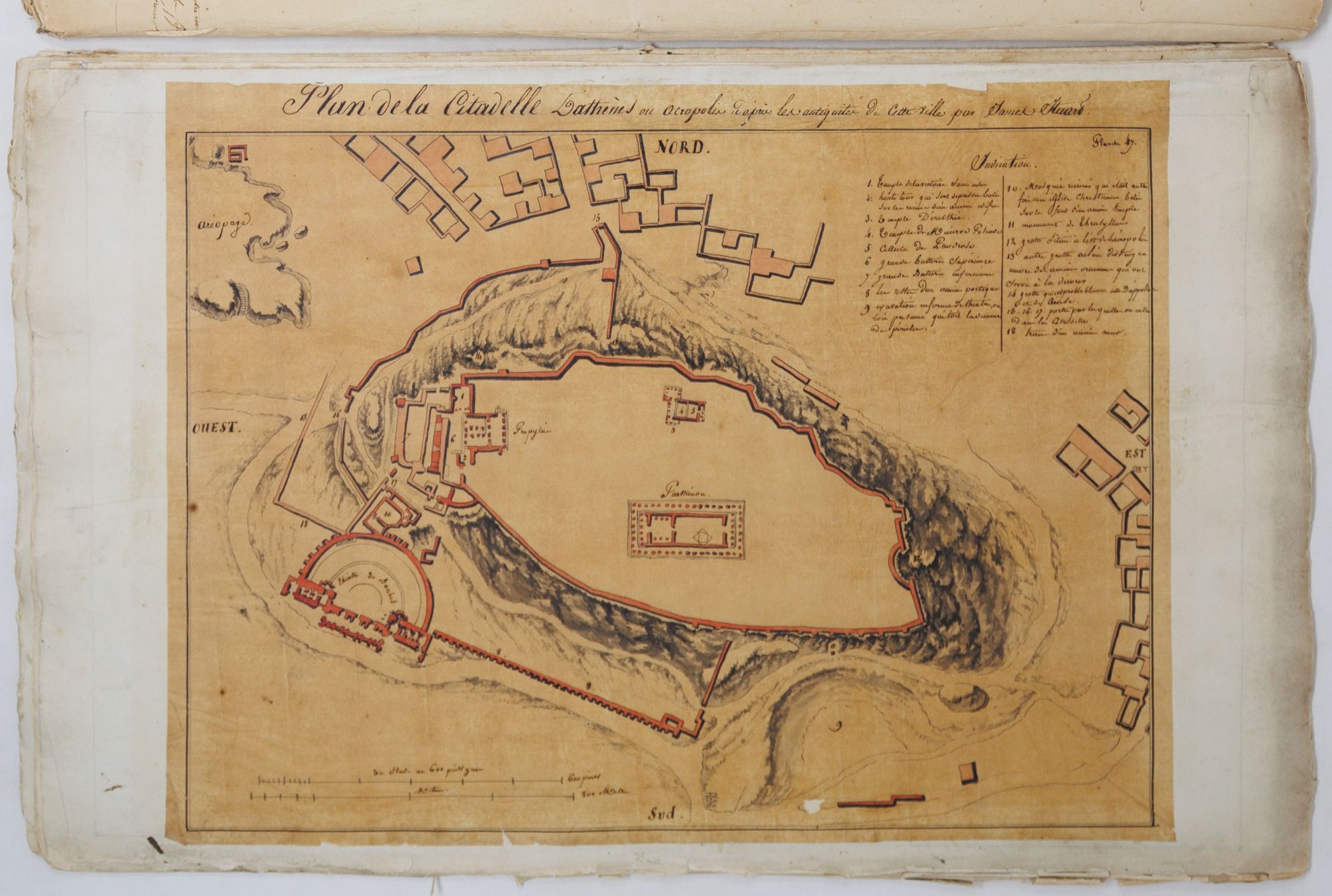
The plates derive mainly from Stuart and Revett. Boutrois and Delettre had reworked the plates (and added a few), issuing them in parts (livraisons) as early as 1802. The main attraction of the plates was their diminished price — about a tenth of the plates of Stuart and Revett — and, from about 1806, the promise of a new analysis by Legrand, which began to be issued in parts as well.[3] This is reflected in the structure of the present work, with explanations of plates — without page numbers — often following the relevant part of the main text. The pasted drawings on tissue naturally suggest tracing, but these have been worked to a considerably finer extent than those in the printed parts. The use of pink wash to indicate where sections have been cut — rendered unshaded in the printed plates, much to their detriment — and some fine ink wash shading (especially at 171r, printed as pl. 47 (the whole of the Acropolis and its surrounds)) — show that these are the work of a trained draughtsman. The blurred boundaries between the tissue and the leaves of the MS proper, with text and occasionally drawing crossing from one to the other, as well as the consistent hand, all point to Legrand himself.
The mind and hand of Legrand are in evidence clearly in the drawing of the east elevation of the Erechtheion (known then as the Pandrosion, “Pandrose” in the text; 142r), printed as pl. 28. A section of a structural wall, labeled D, shows a knowledge of ancient building techniques: a rubble core faced with an even thickness of ashlar. In the printed plate, this has been made to appear as a core of bricks faced with irregular ashlar, which is muddled. Three intended plates — 12bis (three drawings of the pediments of the Parthenon after Spon/Wheler and Stuart), 13bis (two metopes of the Parthenon) and 13ter (a detail of the north end of the west pediment of the Parthenon) — are not present in the Bibliothèque nationale de France copy of the published work (though they may have been published). Given the vexed history of the reconstruction of the Parthenon pediments (and their unparalleled importance to the history of Greek art), these plates are most interesting.
The published work is recorded at auction only once. Printer’s copy is rare in any period, largely because it was often disbound and disseminated (cast off) to typesetters. (The graphite crosses against written lines of text in the margins of most pages suggest some stepwise process — either editorial or typesetting — though the absence of quire markings suggests the former.) Ordinarily it allows for glimpses into small changes made at the press — punctuation, spelling, paragraph breaks and so forth — but in the present case the gap between the manuscript and the printed book is substantial.
Plates (foll. 112r-222r):
112r: pl. A in two parts, pl. B
112v: pl. 1, pl. 2
121r: pl. 3, pl. 4
121v: pll. 6 & 5 in one
122r: pll. 13 & 13bis in one (pl. 13bis not publ.), pl. 12bis (not publ.), 13ter(ne?) (not publ.)
122v: pl. 7, pl. 8 in four parts (pl. 8 reversed = Parthenon N XII (corrected in print)), pl. 9 in two parts
131r: pl. 10, pl. 11 in two parts, pl. 12 in two parts
131v: pll. 17, 16 & 15 in one; pl. 14
132r: pl. 18, pl. 19
132v: pl. 20, pl. 21
141r: pl. 22, pl. 23 in two parts, pl. 24 in two parts
141v: pl. 25, pl. 26
142r: pl. 28, pl. 27
142v: pl. 29, pl. 30
151r: pll. 31 & 32 in one
151v: pll. 33 & 34 in one
152r: pll. 35 & 36 in one
152v: pl. 38 in two parts (lower part not numbered)
161r: pll. 39 & 40 in one
151v: pl. 42, unnumbered plate (=pl. 43 printed)
162r: pl. 44, pl. 45
162v: pll. 41 & 46 in one
171r: pl. 47
171v: pll. 48 & 49 in one
172r: pl. 51, pl. 50
172v: pll. 52 & 54 in one
181r: pll. 53 & 55 in one
181v: pll. 56 & 57 in one
182r: pll. 58 & 59 in one
182v: pll. 60 & 61 in one
191r: pll. 62 & 63 in one
191v: pl. 64, pl. 67
192r: pll. 65 & 66 in one
192v: pll. 68 & 69 in one
201r: pl. 70, pl. 61
201v: pl. 72, pl. 73
202r: pl. 74, pl. 75
202v: pl. 76, pl. 77, pl. 78
211r: pl. 79 (printed as pll. 79 & 80), pl. 81
211v: unnumbered pl. (printed as pl. 82), pl. 83
212r: pl. 84, unnumbered pl. (printed as pll. 85 & 86)
212v: pl. 87, pl. 88
221r: pl. 89
221v: pll. 90 & 91 in one
222r: pl. 92, pl. 93
Purchased at Sotheby’s New York, 13 June 1991 (lot 55).
Printed edition: Brunet, III.946; Cicognara 2678; Quérard I.481 and V.106.
[1] Sources agree that he died on the 10th (or 9th) of November, but differ on the year. VIAF gives the 1807 date (as does the account of his tombstone), but early sources (e.g., Legrand’s posthumous Essai sur l’histoire générale de l’architecture, Paris: Soyer, 1809; p. 10) give 1808. Braham’s 1989 Architecture of the French Enlightenment (p. 110) gives 1809.
[2] At 122v, Legrand compares the plate to “mon vignole de detournelle,” which must refer to a copy in his library.
[3] Quérard I.481 indicates that the full text was available by 1807. Here questions of the date of Legrand’s death become particularly relevant.
Item #JLR0248
Price: $85,000