

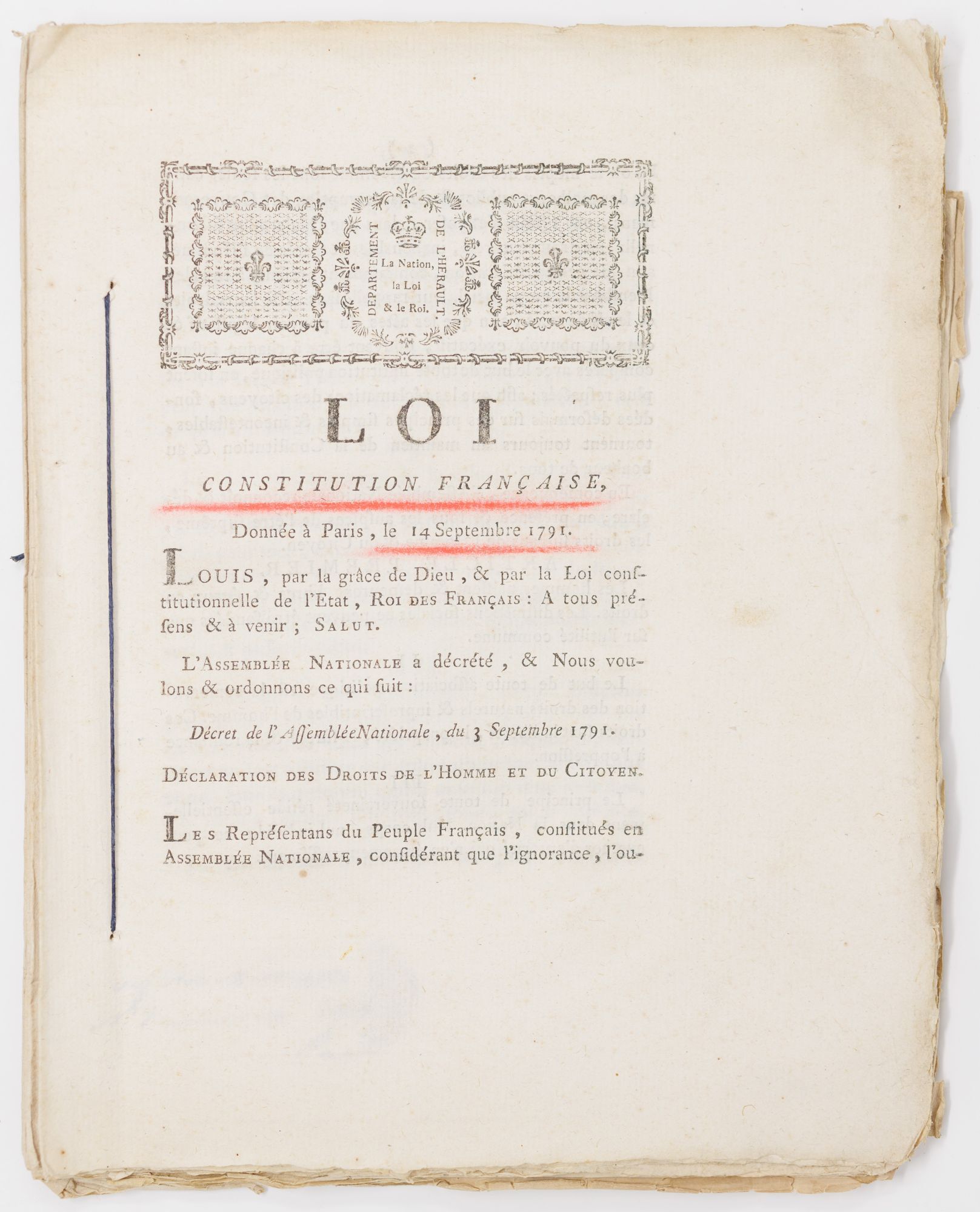


Loi constitution française, Donnée à Paris, le 14 September 1791 BOUND WITH Loi Relative à la proclamation de la Loi Constitutionnelle AND WITH Extrait du procès-verbal des séances du Directoire du Departement de l'Herault, Du Mercredi 28 September mil sept cent quatre-vingt-onze
“LES HOMMES NAISSENT & DEMEURENT LIBRES & ÉGAUX EN DROITS”
THE VANISHINGLY-RARE FIRST EDITION OF THE FRENCH CONSTITUTION
[French Constitution of 1791.] Loi constitution française, Donnée à Paris, le 14 September 1791. Montpellier: Jean-François Picot, 1791. First edition.
bound with
Loi Relative à la proclamation de la Loi Constitutionnelle. Donnée à Paris, le 15 Septembre 1791. Montpellier: Jean-François Picot, 1791. First edition.
and with
Extrait du procès-verbal des séances du Directoire du Departement de l’Herault, Du Mercredi 28 September mil sept cent quatre-vingt-onze. Montpellier: Jean-François Picot, 1791. First edition.
Quartos.
Constitution (10 ¾” x 8 5/8”, 273mm x 218mm): A4 B-H4 (H4 blank) [$1 signed]. 32 leaves, pp. 1 2-62, 2 blanks.
Proclamation (9 13/16” x 7 7/8”, 250mm x 201mm): 2 leaves, pp. 1 2-3, blank.
Extrait (10 1/8” x 7 7/8”, 255mm x 203mm): A4 (A4 blank). 4 leaves, pp. 1 2-6, 2 blanks.
Stab-bound (perhaps a later string). Proclamation and Extrait bound in sequentially at D2.3 (between pp. 28 and 29) Constitution with holes from an earlier (narrower) stab-binding. The upper stab missing the Proclamation, which is evenly tanned. Underlining in red crayon to “constitution française” and “le 14 Septembre 1791.” on the first page of the Constitution . With deckled edges at top, fore and lower edges. Some tanning, chipping and creasing at the deckles. Proclamation verified and certified in ink manuscript (p. 3) dated “Beziers le 7.e 8.bre 1791” by the administrators of the Directoire of the District of (completed manuscript) Beziers, with three signatures in ink manuscript. Constitution verified and certified in ink manuscript (p. 62) dated “Beziers le 6 8bre 1791” by the administrators of the Directoire of the District of (not completed manuscript) Beziers, with three signatures — the first two the same as in the Proclamation, the third different (see below) — in ink manuscript.
The principal aim of the French Revolution was the end of absolute monarchy and the institution of a written constitution that would apply to all citizens. In one of the great coincidences of history, the French constitutional committee met for the first time on 14 July 1789, the same day on which the Bastille was stormed. The new radicalism — the rejection of royal veto powers, presaging the abolition of the monarchy altogether — necessitated the creation of a second committee, which, by September 1791, delivered the finished constitution to Louis XVI, who signed it against his will.
The 1791 Constitution, ratified 14 September 1791, was the first to obtain in France, and expanded on the nebulous Déclaration des droits de l’Homme et du citoyen (carried over in modified form as a preamble) and set into law its core promise as article 1: “Les hommes naissent & demeurent libres & égaux en droits. Les distinctions sociales ne peuvent être fondées que sur l’utilité commune” (Men are born and remain free and equal in rights. Social distinctions cannot be founded on anything but the common good). Although the First Republic lasted only eight years, the governance of France by means of a written constitution defines its modern era.
As with the American Constitution, the French government had the Constitution printed in the various départements (83 at that time, now 101) that replaced the old provinces and promulgated the new code of laws to the citizens whose rights it enshrined. Though the text is fundamentally the same, each department produced a unique printed object; in the text-ornament at the head of the text, for instance, “DEPARTEMENT DE L’HERAULT.” flanks the coronetted motto of the Kingdom of France (i.e., the constitutional monarchy of 1791–1792): “La Nation, la Loi & le Roi”. More particularly, the final page of the document provides for the verification and certification of the administrators of various districts within the department. The present example was for the ancient city of Béziers, and it was signed by their administrators 6 October (8bre referring to the Latin “octo” for 8) 1791, 22 days after the constitution was ratified by the king. It is difficult to identify the signatories, but the first two (Laplace and ?) are the same for both the Constitution and the Proclamation; the third for each differs.
Brief mention should be made of the two smaller pamphlets bound in. The first (Loi Relative à la proclamation de la Loi Constitutionnelle), passed the day after the Constitution, specifies that the text of the constitution is to be proclaimed and disseminated in the various departments; i.e., it is the law that provides for the printing of the principal text. The second (Extrait du procès-verbal des séances du Directoire du Departement de l’Herault) reflects a speech given in Montpellier 28 September 1791 by (Charles) Dupin extolling the virtues of the Constitution and urging its promulgation. Together they give the context for the Montpellier printing of the Constitution.
OCLC records 25 examples of the Loi constitution française (sometimes françoise) in institutional collections (separate; they may also have been included in larger compilations).[1] The commonest imprint is, unsurprisingly, Paris (6), followed by 2 each from Strasburg, Bar-Le-Duc and Caen. The remaining imprints are from Aix, Angers, Bar-Le-Duc, Clermont-Ferrand, Colmar, Laon, Montpellier (see below), Nevers, Orleans, Pau, Perpignan, Poitiers, Rouen and Toulouse. OCLC records a Montpellier imprint (as here) at Tokai University, although their own listing records the imprint as Paris. It is unlikely but possible that the present item is therefore the only surviving separate example from Picot’s Montpellier press. Certainly in its entirely unsophisticated state (the re-stabbing must have occurred when the two smaller pamphlets were included, likely very shortly after the publication of the Constitution), with deckled edges and its official verification, the present work is a precious primary record of the emergence of French democracy.
See Duvergier, Collection complète des lois III.239ff.
None of the 3 in Martin & Walter, Catalogue de l’histoire de la révolution française.
Catalogued by JL Rosenberg (D.Phil, Oxon.)
and Sophie Fyfe
[1] Aix: University of Maryland, College Park; Angers: Yale; Bar-Le-Duc: National Library of Australia, New York Public Library; Caen: Cornell, Bibliothèque Geneve; Clermont-Ferrand: Lafayette College; Colmar: Universitätsbiblothek Freiburg; Laon: Sachsische Landesbibliothek; Montpellier*: Tokai University; Nevers: Institut Catholique de Paris; Orleans: Northwestern University; Paris: Bibliothèque nationale de France, Bibliothèque municipale de Lyon, National Library of Scotland, Staatsbibliothek Berlin, International Institute of Social History (Amsterdam), University of Haifa; Pau: University of California at Berkeley; Perpignan: Universitat de Barcelona; Poitiers: University of Maryland, College Park; Rouen: Newberry Library; Strasburg: Universitätsbibliothek Heidelberg, Universitätsbibliothek Tübingen; Toulouse: Bibiliothèque nationale de France.
Item #JLR0636
Price: $2,400